A Closer Look at Kilometers and Laps at the Run for Health
Our Run for Health (Beh pre zdravie) is first and foremost a great social event focused on the joy of movement, strengthening the community, and supporting your class. The track brings together fast runners, walkers, parents, children, and participants in wheelchairs—and in the end, everyone who joins us is a winner.
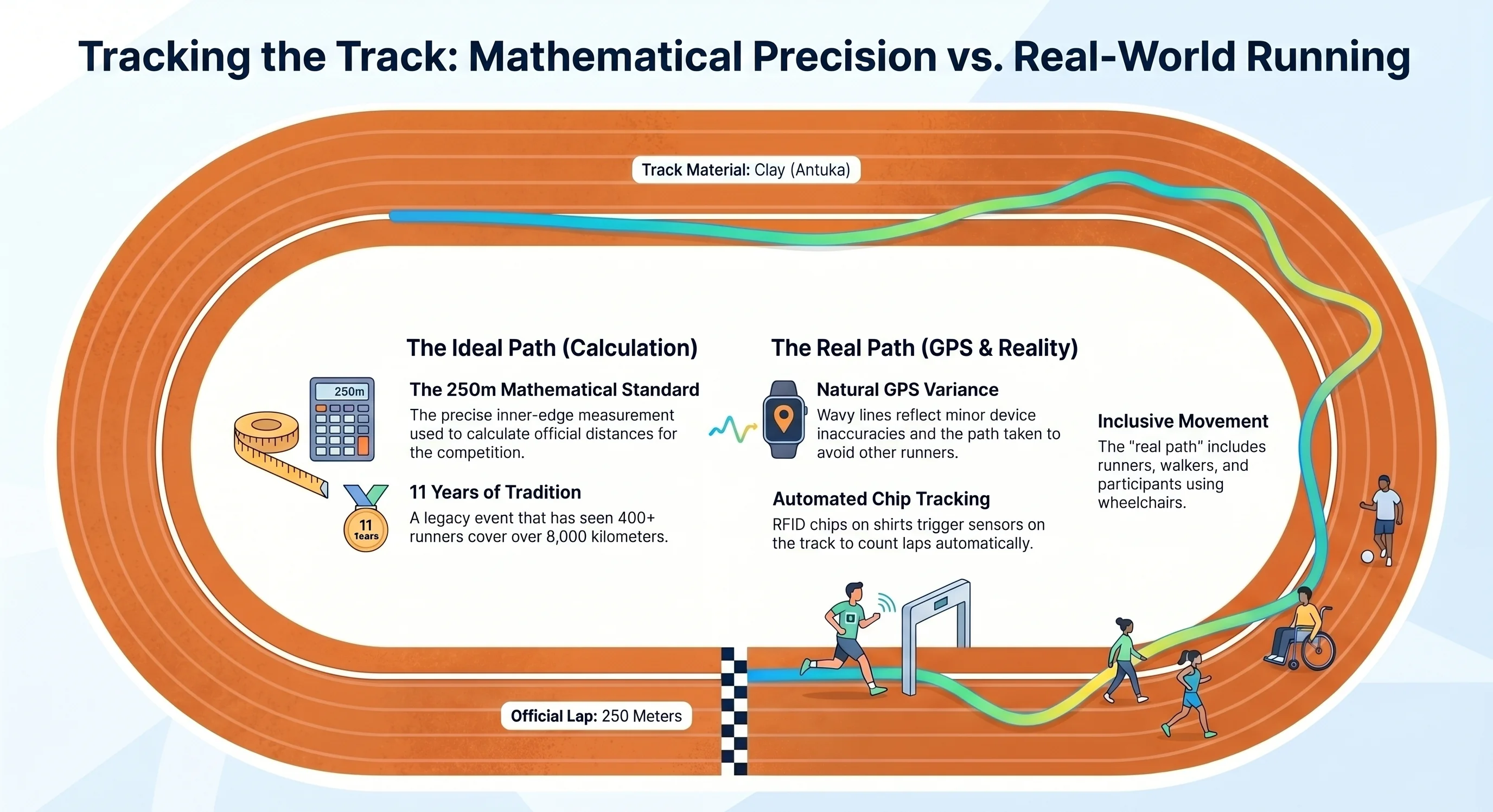
As you know, in our competition, we fight for the number of completed laps. The kilometers you see in the overall results (where we roughly divide the number of laps by 4, as a lap is 250m long) serve exclusively to give you a better idea of the distance covered.
At the same time, we’ve noticed an interesting topic that you often discuss with us on the track: "My running watch measured more than the official results show." We would like to offer one perspective on why this situation occurs.
Track Mathematics and Satellites on Our Wrists
Our favorite cinder track at the Kúty Elementary School has a rectangular shape with rounded corners. Since the track is wide (approximately 5 meters) and gets quite busy—with runners overtaking, changing pace, or avoiding slower participants—hardly anyone can run the ideal inner line. Every single step toward the outer edge actually increases the length of your lap.
Technology is another factor. Several independent studies on the accuracy of GPS/GNSS devices point out that sports watches tend to be inaccurate on short, narrow loops (especially those with rounded shapes). Algorithms in the watches may slightly "smooth out" corners during constant turning, or the signal may "jump" for a fraction of a second, leading to extra meters being recorded.
What is Common and When Should You Pay Attention?
Due to the combination of zigzagging on the track and the technological limits of GPS, a common discrepancy on our type of loop is considered to be between 5% and 10%.
What does this mean in practice? If you run 40 laps (which is our estimated conversion for 10 km), your watch may easily show 10.5 to 11 km. Such a result is completely natural.
How We Measure Laps and How You Can Help Us
To record passes, we use a chip system that triggers when running over a sensing element on the track. However, it is entirely natural that given the huge number of participants (often more than 400 runners) and situations where crowds pass through the finish line at once, there may be exceptional moments when the system does not register a pass.
That’s why we have an interval timing system in place and do our best to identify and reconstruct any missing data by combining available information.
When Should You Contact Us?
If the discrepancy on your watch after finishing is significantly larger than the aforementioned 5–10% (which could signal that we actually missed a lap during measurement), we would be very grateful if you could reach out and provide us with details from your activity. Your feedback is vital to us and allows us to constantly improve.
Fairness and Statistics in Conclusion
Statistically speaking, with a normal distribution of measurement error, the probability of a missed reading is similar for every participant. The main way to minimize errors on your part is the correct placement of the chip. We recommend attaching the chip card to your shirt at a height of at least 1 meter, ideally oriented "vertically" (exactly according to the instructions found in our runner information guide). By doing this, we collectively ensure maximum fairness for all competing classes.
However, the most important thing remains the essence: every extra lap, whether captured by the system or just by your watch, is a step forward for your health. We look forward to seeing you on the track!
Your Run for Health Team.